The complete, practitioner-built system for going from zero Python to backtesting strategies, analyzing market data, and automating trades — in less than 1 hour a day.
Start Using Python for Quant Finance →⭐️ ⭐️ ⭐️ ⭐️ ⭐️
"This was the best course I have taken in my 28-year career in finance." — Zarko, Finance Professional
You googled “learn Python for finance.”
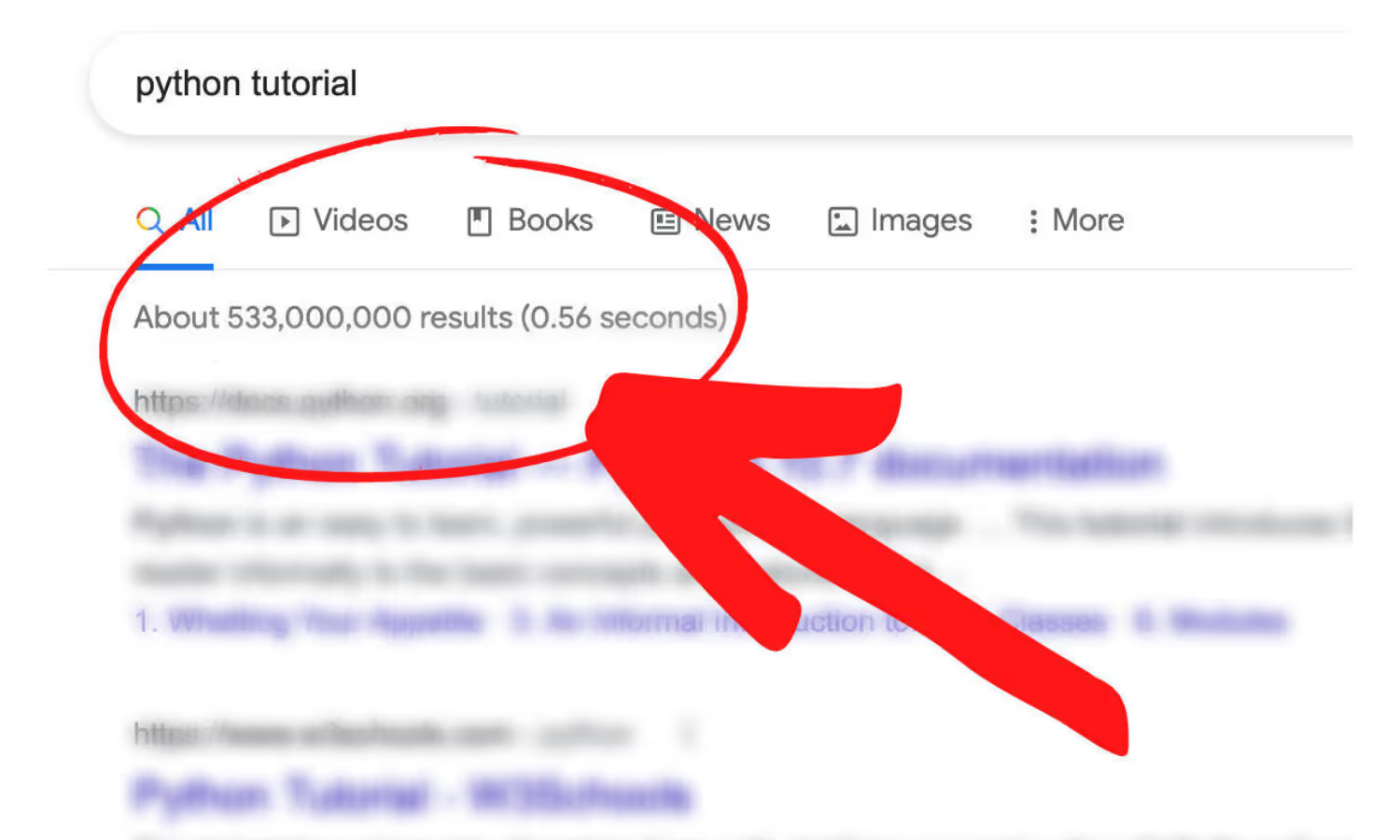
You got 533 million results. You picked the first paid ad and spent $19 on a Udemy course.
You learned how to print “Hello World” and build a tic-tac-toe game from someone who has never traded a share, priced a derivative, or sat on a risk desk.
Then you tried another course. More syntax drills. More toy examples. Still no idea how to pull market data, build a backtest, or connect to a broker.
You’re not failing because you’re bad at Python.
You’re failing because nobody taught you Python for the thing you actually want to do.
The generic courses teach you programming. They don’t teach you how a quant uses Python to analyze $20 billion in derivatives exposure, or how a trader uses it to automate execution on Interactive Brokers, or how an analyst uses it to screen 21,000+ equities with factor pipelines.
That’s what this course teaches.
But first, let me show you why I built it.
I traded my first stock and wrote my first line of code at 18.
Since then, I’ve spent 20+ years at the intersection of Python, trading, and quantitative finance:
Derivatives trader for a hedge fund and energy trading firm in Chicago, generating several million dollars in P&L
Credit quant managing $20 billion in derivatives exposure and a $100 million CVA book
Global team lead building all market risk analytics for a $7 billion derivatives business
Head of data engineering and quant analysis for a $60 billion metals trading operation
I taught myself Python in 2012 to avoid paying $2,000/year for a MATLAB license. Best trade I ever made.
I started PyQuant News in 2015 to share what I’d learned. Eleven years later, 1,500+ students and 200,000+ newsletter subscribers later, I’m still at it.
Every week, someone asks me the same question:
“Jason, I know Python is important for quant finance. Where do I actually start?”
The honest answer used to be: nowhere good. The Python-for-finance courses out there fell into two camps — either generic programming tutorials with a finance coat of paint, or PhD-level theory with no practical code.
So I built the thing I wished existed when I was starting out. A complete, step-by-step system that teaches Python the way a quant actually uses it — with real market data, real backtesting frameworks, and real broker integration.
1,500+ students have gone through it. Here’s what they say.

"This was the best course I have taken in my 28-year career in finance."
"I've explored most of the quantitative finance courses out there and found this to be the most practical and efficient course currently available."
"The course gave me the materials I needed with a mentor to guide me along the way to achieve my end goal of landing an active trader role."
"I consider it one of the best investment decisions I have taken this year. Five weeks ago I didn't know what quant finance was. Since I took the course, a new world has opened to me which will boost my options trading."
"I have no coding experience and no technical background. I went from no direction with Python to having a clear path in a month."
"Great course whether you're a beginner or an experienced Python user. The shared notebooks alone are worth multiples of the course cost. I signed up for round 3!"
"This was by far the best trading class I have ever taken."
"I learned much from this course about both Python and quant finance, all of which was dependent upon the incredible support provided by Jason individually and by the PQN community."
Getting Started With Python for Quant Finance is a complete practitioner system: 20 hours of instruction across 13 modules, 40+ code templates with real market data, and a 1,500-person community of finance professionals who use Python daily.
You’ll get the same tools I used to manage $20 billion in derivatives exposure, run a $100 million CVA book, and trade stocks and options from my home office.
Every module is designed around one principle: you should be able to use what you learn the same day you learn it.
Here’s exactly what’s inside.
If you’re brand new to Python, start here. We skip the computer science theory and cover exactly what a quant needs: data types, data structures, control flow, functions, and classes — with finance examples, not toy problems. You’ll be writing useful code by the end of the first day.

Pandas is to quant finance what Excel wishes it could be. You’ll learn to load, clean, transform, and analyze market data — the same workflows I used across every quant role I’ve held. After this module, you’ll wonder how you ever worked without it.

The harsh truth: most people backtest wrong, form strategies wrong, and execute wrong. In this module, you’ll get the 8-step process for strategy formation that separates retail hobbyists from systematic traders. Yes, retail traders can compete — but only if they do this correctly.

Most people optimize parameters to maximize profit. That’s exactly how you lose money. You’ll learn to treat backtests as experiments — with statistical rigor that reveals whether your strategy has genuine edge or just curve-fitted noise.

Most people have heard of alpha. Few can define it precisely, let alone capture it. You’ll build alpha factors from scratch, learn to hedge away beta exposure, and use the same factor engineering techniques used at institutional asset managers.

VectorBT is a vector-based backtesting framework that does in seconds what traditional frameworks do in hours. You’ll optimize entry and exit signals across massive parameter spaces and see exactly which combinations produce real edge.

Zipline Reloaded is the most robust event-based backtesting framework available in Python. You’ll build factor pipelines that screen, rank, and allocate across a universe of 21,000+ equities — the same approach used by quantitative hedge funds.

Cumulative returns look great until drawdowns destroy your capital. You’ll use Pyfolio and Alphalens to analyze risk-adjusted performance, factor exposures, alpha decay, and drawdown periods — so you know exactly when a strategy is working and when to cut it.

The final piece: execution. You’ll build the scaffolding for a live trading application using the Interactive Brokers API — downloading real-time data, submitting orders, and monitoring positions. This is where everything comes together.

You’ve gone from zero to a working Python-based trading pipeline. In this final module, we map out your next steps — whether that’s advanced strategies, the QS Pro algorithmic trading system, or building your own research operation.

Every template includes a 20-minute video walkthrough and real quant code. Copy, modify, and run — in Jupyter, on real market data.
6 templates for building foundational risk metrics, cumulative return analysis, Sharpe ratios, and drawdown analysis.

4 templates for pricing options, building volatility surfaces, and forecasting implied volatility for trading edge.

4 templates for factor-based investing, beta-neutral portfolio construction, and risk decomposition.

5 templates for building, testing, and deploying systematic trading strategies with broker integration.

You can. And you’ll spend 6 months watching videos from people who’ve never sat on a trading desk, piecing together fragments that don’t connect, debugging code that was outdated 2 years ago. YouTube is a great place to learn what’s possible. It’s a terrible place to learn how to do it systematically. This course saves you months of wasted time by giving you the exact sequence, code, and frameworks — built by someone with 20 years of industry experience.
Module 1 starts with the basics — data types, functions, and classes — with finance examples, not computer science theory. The pace ramps up, but you have lifetime access, 1,500+ community members to ask questions, and an instructor who’s taught people from zero-experience analysts to 30-year software engineers. Over 1,500 people have completed this course. Many started exactly where you are.
The course is designed for less than 1 hour per day. All content is self-paced with lifetime access. No deadlines. No cohort schedule. If you miss a week, the content is still there. If you need 3 months instead of 6 weeks, take 3 months.
At $1,000, this costs less than 2 months of a Bloomberg terminal — and unlike Bloomberg, you keep access forever. The 40+ code templates alone took hundreds of hours to develop. The PQN Pro community has 1,500+ active members. The aggregate review score is 4.97 out of 5.0 across 100+ reviews, with a refund rate below 0.1%. Price-per-hour of instruction is under $50 for 20 hours of content — before counting the code templates, bonuses, and community access.
Every bonus solves a specific problem you’ll hit as you build your Python-based trading operation.


13 modules, 134 lessons (20 hours)
Self-paced video instruction with Q&A. A private quant tutor runs $400/hr
$8,000
40+ Jupyter code templates
19 with video walkthroughs, real market data. Rich (hedge fund manager) said "the shared notebooks alone are worth multiples of the course cost."
$2,000
PQN Pro community (lifetime)
1,500+ finance professionals, developers, traders. Comparable Slack/Discord quant communities charge $100/month.
$1,500
Partner bonuses & credits
IBKR stock, data discounts, platform access. Load up on freebies.
$4,500
Real-time support & Q&A
Direct access to Jason + community debugging. Access to Jason + community for debugging and guidance. Equivalent of ~5 hours of consulting.
$1,000
Total value
$17,000
One payment. Lifetime access. Everything above included.
You save $16,000 (94%)
Start Using Python for Quant Finance →If you hired a quant consultant to teach you this material 1-on-1, you’d pay $400/hour. At 20 hours of instruction, that’s $8,000 — without the code, the community, or the bonuses.
A single semester of quantitative finance at a top university costs $15,000. A Bloomberg terminal costs $24,000/year.
Not everyone is right for this course and I don’t want to waste your time.
✓ You want to use Python for market data analysis, backtesting, and automated trading
✓ You're tired of paying for generic courses that have nothing to do with quant finance
✓ You want an opinionated, structured path — not "figure it out yourself"
✓ You're brand new to Python, quant finance, or both
✓ You want step-by-step guidance from someone with 20+ years of industry experience
✓ You prefer hands-on instruction with zero fluff
✓ You don't have time to waste and want to know just what you need
✗ You want pure theory with no practical application
✗ You think buying a course will hand you profitable strategies without work
✗ You don't need Python in your field and won't anytime soon
✗ You're happy with Excel and unwilling to change tools
✗ You want a computer science fundamentals course (memory management, data structures, algorithms)
✗ You want to brute-force optimize backtests and data-mine the market
You have lifetime access. All modules, code notebooks, written curriculum, and the PQN Pro community — available whenever you’re ready. No deadlines. No expiration.
Module 1 covers the Python basics you need for quant finance. The pace increases from there, but you have lifetime access to revisit any module, and 1,500+ community members to help you through rough spots. Complete beginners have completed this course successfully.
Several students have been software engineers for 20-30 years. They skip Module 1 and go straight to the quant-specific content — factor engineering, backtesting, risk analysis, broker integration. The code templates alone justify the investment for experienced devs.
Udemy’s business model requires you to take course after course. They teach the broadest topics to the widest audience so you stay on their platform. Their incentives aren’t aligned with yours. Mine are: get you outcomes with Python for quant finance. I lose if you can’t use what you learn. The 4.97/5.0 aggregate rating across 100+ reviews and <0.1% refund rate speak to that alignment.
No. Only 3 of the 40+ code templates are specific to Interactive Brokers. 99% of the course applies to any broker or data source.
Techniques like conditional value at risk, factor investing, and options valuation work in all markets. The code templates are designed to be modified for your specific instruments and exchanges.
Less than 1 hour per day. The course is fully self-paced with lifetime access.
No. I’ve spent 11 years building a reputation for delivering the highest quality products. I have 1,500+ students, a <0.1% refund rate, and 100+ five-star reviews. This course is not for tire-kickers. It’s for people who are committed to the process. If that’s you, there’s zero chance you’ll be disappointed. If you’re just curious, please don’t buy the course.
I’m public online. My personal identity is tied to the PyQuant News brand across LinkedIn, Twitter, and every other platform. 1,500+ people have trusted me to get them outcomes. You can verify that through the reviews on this page.
13 modules, 134 lessons (20 hours)
Self-paced video instruction with Q&A. A private quant tutor runs $400/hr
$8,000
40+ Jupyter code templates
19 with video walkthroughs, real market data. Rich (hedge fund manager) said "the shared notebooks alone are worth multiples of the course cost."
$2,000
PQN Pro community (lifetime)
1,500+ finance professionals, developers, traders. Comparable Slack/Discord quant communities charge $100/month.
$1,500
Partner bonuses & credits
IBKR stock, data discounts, platform access. Load up on freebies.
$4,500
Real-time support & Q&A
Direct access to Jason + community debugging. Access to Jason + community for debugging and guidance. Equivalent of ~5 hours of consulting.
$1,000
Total value
$17,000
One payment. Lifetime access. Everything above included.
You save $16,000 (94%)
Start Using Python for Quant Finance →1,500+ students. 4.97/5.0 rating. Less than 0.1% refund rate.